




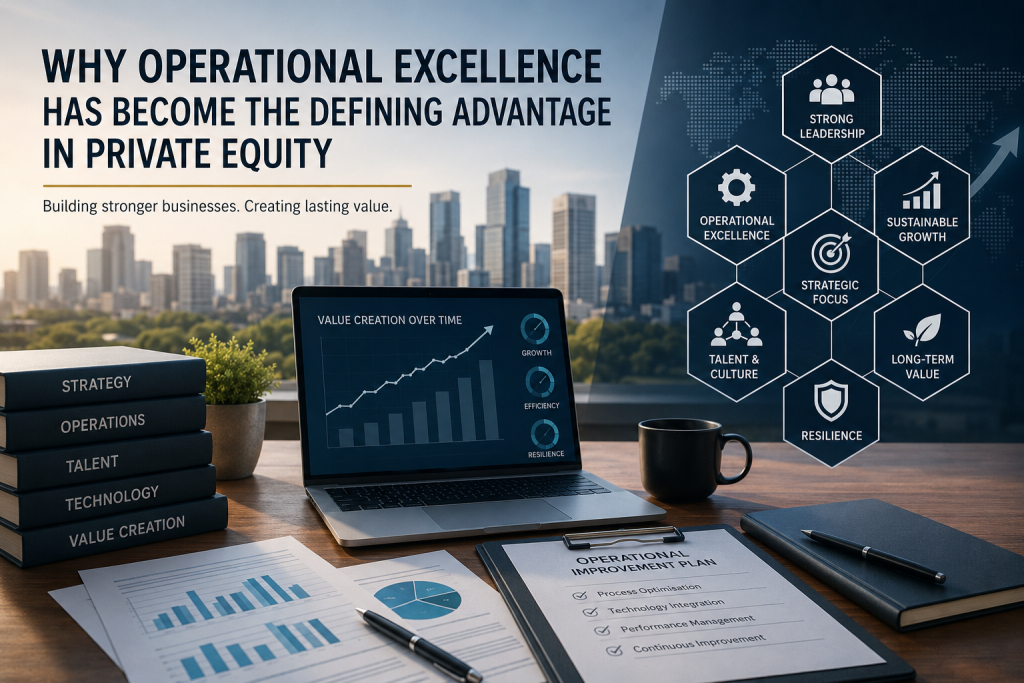
Private equity has long been associated with capital allocation, financial engineering, and strategic acquisitions. Yet over the past two decades, the industry has undergone a significant transformation. In mature markets, where competition for quality assets is intense and valuation multiples remain elevated, operational excellence has emerged as one of the most important drivers of long-term value creation.
Investors increasingly recognise that sustainable returns cannot rely solely on buying assets at attractive prices and exiting at higher valuations. Instead, value is created through systematic improvements in business performance, leadership development, and strategic execution. Discussions around long-term investment ecosystems often highlight the importance of institutional frameworks and community-driven economic development. Some broader perspectives on these themes can be explored according to this source, which reflects how long-term value creation frequently depends on structures that extend beyond short-term financial objectives.
The modern private equity model reflects this shift. Successful investors are increasingly acting as business builders rather than simply financial sponsors. The focus has moved toward operational transformation, resilience, and long-term competitiveness.
The Evolution of Private Equity Beyond Financial Engineering
Historically, many private equity strategies relied heavily on leverage and multiple expansion to generate returns. During periods of favourable economic growth and lower interest rates, these approaches often delivered strong outcomes.
However, mature markets have become increasingly efficient. Information is more widely available, competition among buyers has intensified, and high-quality assets rarely remain undervalued for long.
As a result, investors can no longer depend primarily on financial structuring to achieve performance targets. Instead, operational improvements now account for a larger share of value creation within many successful portfolios.
This evolution has changed how investment teams evaluate opportunities and how portfolio companies are managed after acquisition.
Why Management Teams Matter More Than Ever
One of the most underestimated factors in private equity performance is leadership quality.
While financial models can estimate revenue growth, margin expansion, and capital expenditure requirements, the execution of those plans ultimately depends on people. Strong management teams are often the difference between a successful investment and a disappointing outcome.
Institutional investors increasingly assess leadership capabilities during due diligence processes. Questions surrounding talent retention, succession planning, organisational culture, and decision-making structures have become central to investment analysis.
A business operating in a mature industry may still generate exceptional returns if its leadership team consistently adapts to changing market conditions and executes strategic initiatives effectively.
In many cases, investors are not simply acquiring assets—they are investing in management’s ability to create future value.
Operational Transformation as a Value Creation Strategy
Operational transformation encompasses a wide range of initiatives designed to improve business performance.
These may include:
- Supply chain optimisation
- Digital transformation
- Process automation
- Pricing improvements
- Customer retention strategies
- Data-driven decision making
- Procurement efficiencies
The goal is not merely cost reduction. Instead, the objective is to build stronger, more competitive organisations capable of sustaining growth through different economic environments.
In mature markets, where industry growth rates may be modest, even incremental operational improvements can significantly increase enterprise value over time.
This approach often generates more durable outcomes than strategies dependent on market timing or favourable macroeconomic conditions.
The Importance of Sector Expertise
As private equity markets have evolved, sector specialisation has become increasingly important.
Generalist investment approaches still exist, but many institutional investors now prioritise deep expertise within specific industries such as:
- Healthcare
- Industrial manufacturing
- Business services
- Software and technology
- Infrastructure-related services
Sector knowledge enables investors to identify structural trends, competitive dynamics, and operational opportunities that may not be immediately visible through financial analysis alone.
Understanding regulatory developments, customer behaviour, technological disruption, and industry-specific risks often creates informational advantages that contribute to better investment decisions.
This trend reflects a broader shift toward knowledge-based investing rather than purely transaction-driven strategies.
Creating Resilience Across Economic Cycles
Economic cycles inevitably influence private equity performance. Periods of expansion create opportunities for growth, while downturns test the resilience of portfolio companies.
The strongest long-term investors often focus less on predicting economic cycles and more on preparing businesses to withstand them.
Resilient companies typically share several characteristics:
- Strong balance sheets
- Diverse customer bases
- Scalable operating models
- Effective leadership teams
- Sustainable competitive advantages
These qualities help businesses navigate periods of uncertainty without sacrificing long-term strategic objectives.
For institutional investors with extended investment horizons, resilience often matters more than short-term performance fluctuations.
The ability to preserve value during challenging periods frequently contributes more to long-term returns than aggressive growth during favourable conditions.
Technology as a Competitive Enabler
Technology has become a central component of modern value creation strategies.
Digital tools enable businesses to improve operational efficiency, enhance customer experiences, and generate actionable insights from data.
Private equity investors increasingly evaluate technology readiness when assessing acquisition targets. The question is no longer whether technology matters, but how effectively an organisation integrates it into daily operations.
Areas receiving significant attention include:
- Artificial intelligence applications
- Advanced analytics
- Cybersecurity
- Cloud infrastructure
- Workflow automation
Technology investments can improve productivity while creating scalability that supports future growth initiatives.
Importantly, these improvements often produce benefits that extend well beyond the investment holding period.
Long-Term Thinking in an Increasingly Short-Term World
Perhaps the most valuable characteristic of successful private equity investing is the ability to maintain a long-term perspective.
Public markets frequently react to quarterly earnings reports and short-term sentiment shifts. Private ownership structures provide greater flexibility to pursue initiatives that may require several years before generating meaningful results.
Long-term thinking encourages investments in:
- Leadership development
- Innovation
- Infrastructure
- Employee capabilities
- Customer relationships
These areas may not deliver immediate financial returns, but they often create durable advantages that compound over time.
Institutional investors increasingly recognise that sustainable value creation rarely occurs through short-term optimisation alone. Instead, it emerges from disciplined execution, strategic patience, and continuous improvement.
The Future of Value Creation in Private Capital
The private equity industry will continue evolving as markets become more competitive and economic conditions become more complex.
Future success is likely to depend less on financial engineering and more on operational expertise, leadership development, technological integration, and long-term strategic thinking.
Investors who can identify businesses with strong foundations and help them improve execution will remain well positioned to generate attractive returns across economic cycles.
In mature markets, sustainable value creation increasingly comes from building better businesses rather than simply buying and selling assets. Operational excellence, combined with disciplined capital allocation, has become the defining competitive advantage in modern private equity.
As institutional investing continues to evolve, the firms that consistently create value will be those that understand a simple principle: lasting returns are often generated through transformation, not transaction.



More Stories
We built this city on development charges…
Making Homes Make Cents: How Affordable Housing is Financed
Two-year IT project at Housing Finance Corporation drags on for eight years, KNEWS