





Olive oil producers in Croatia are optimistic about the small Adriatic country’s imminent ascension to the Eurozone at the start of next year.
On January 1st Croatia will become the twentieth member of the single currency union, completing a stated objective of the country since it joined the European Union in 2013.
Exports, especially to other member states of the Eurozone, will be much easier in the future and also much cheaper for the producer.
“The introduction of the Euro will strengthen our economy, it will be an anchor of stability, will make us more resistant and protected from external shocks and crises and will contribute to the improvement of investment climate,” said Marko Primorac, Croatia’s finance minister.
Multiple olive growers and oil producers told Olive Oil Times that they anticipate joining the Eurozone will favour their businesses.
See Also:Italian and Croatian Olive Growers Test New Carbon Credit Project
They cited the simplification of their accounting procedures, better foreign exchange rates to third-party markets and boosted sales from increased tourism as some of the main benefits of the decision.
“In my opinion joining the Eurozone is a very good thing,” Vedrana Rakovac, the award-winning producer behind OPG Rakovac, told Olive Oil Times. “Being in the Eurozone is something that feels very natural for us.”
Located in Istria, a peninsula in the Adriatic Sea shared by Croatia and Slovenia, a Eurozone member, Rakovac frequently travels to the Eurozone, and many of her customers live in the single currency union.
“In Istria, we live near the current Eurozone border,” she said. “We are used to dealing with Euros, and we always accepted payment in Euros, as well as in Croatian kunas and had pricelists in both currencies.”
“Our day-to-day business practices will be easier,” Rakovac added. “We are a small producer. We write our receipts by hand. In the summer, when we have a lot of visitors in our little tasting room, writing the receipts in kunas – because of Croatian regulation – as well as in Euros because our customers pay in Euros, was quite tiresome.”
Rudolf Nemetschke, an investment banker and award-winning producer at Avistria, told Olive Oil Times that he believes joining the Eurozone will immensely benefit producers who export their olive oil to other countries in the currency union and globally.
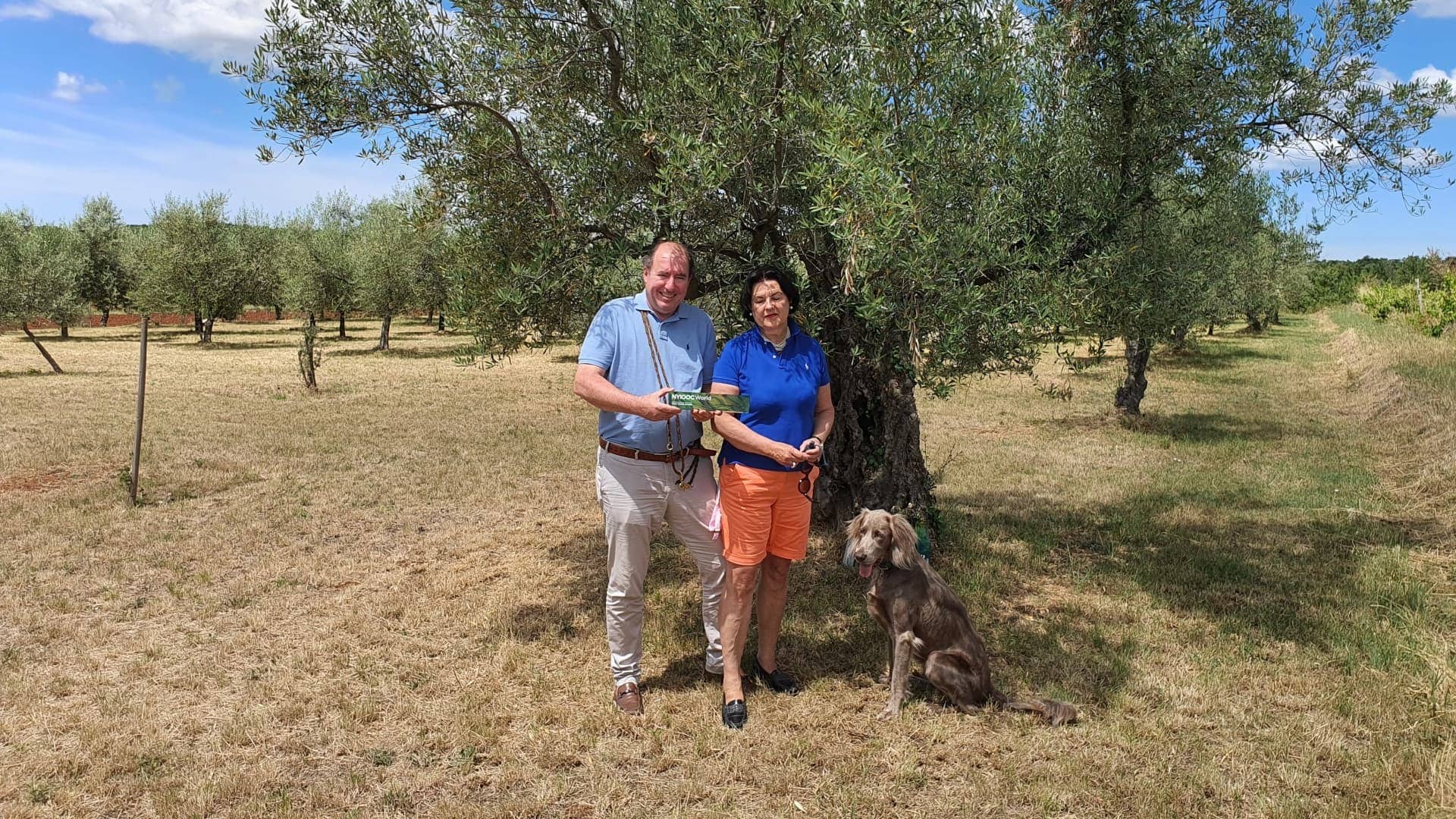
Rudolf and Beatrix Nemetschke of Avistria
Nemetschke, who produces olive oil in Croatia to export to Austria, said joining the single currency will eliminate inconveniences and expenses associated with foreign exchange (FX).
“Exports, especially to other member states of the Eurozone, will be much easier in the future and also much cheaper for the producer, as FX fees no longer have to be paid,” he said. “But also exports to non‑E.U. countries will profit, as the Euro is much easier to trade than the kuna, with far lower spreads and lower FX fees.”
He added that the recent depreciation of the Euro against other global currencies would make Croatian olive oil cheaper to import outside of Europe.
Marina Božac Marjanović, the award-winning producer behind Stancija St. Antonio, agreed that joining the Eurozone will simplify the procedures to export olive oil to other currency union members and hopes the change will result in more sales to customers in other member countries.
“However, we don’t think converting to the Euro will change anything regarding exports to other countries in the rest of the world,” she added. “The impact we expect to see would only be on the countries in Eurozone.”
Officials in Zagreb, Croatia’s capital, who championed the decision, believe adopting the Euro would result in a more stable exchange rate and improve the country’s credit rating.
However, its opponents argue that it will raise prices at a time when annual inflation in the country has reached double digits.
Nemetschke said rising prices due to the adoption of the Euro would positively impact producers when selling their olive oil but would also raise production costs.
“My estimate is that prices of high-quality Croatian – especially Istrian – olive oil will rise, which is good for the growers and producers,” he said.
“On the other hand, rising prices for power fuel and fertilizer will hurt, but it is unclear if these price rises are due to the joining of the Eurozone or just temporary phenomena,” Nemetschke added.
Rakovac agreed that changing from kuna to Euros would likely increase some input prices for growers and producers.
“But in these times, when the inflation rate in Croatia in December 2022 reached 13.5 percent, the increase in expenses caused by conversion is not our biggest fear,” she added.
Paul O’Grady, co-owner and sales director of Brist, added that European rules are aimed at preventing producers from raising their prices to coincide with the currency switch beyond a few percentage points. As a result, he said this would likely mitigate some of the potential associated price increases at the time of currency changeover.

Paul O’Grady, Lena Puhar and their children
Croatia’s final step to joining the Euro came at the end of November when the parliament passed the first national budget in Euros instead of kuna by a vote of 77 to 50.
The path to this decision was paved over the summer when the European Central Bank gave Croatia the green light to join the single currency, prompting E.U. finance ministers to agree to admit Croatia to the Eurozone.
A separate decision earlier this month will also see Croatia join the border-free Schengen zone, which eliminates border checks with other members.
While trade associations anticipate the decision will boost tourism and consumer spending, Nemetschke said it would have little impact on the olive oil sector.
“The Schengen zone membership will have no direct influence, as Croatia already joined the E.U. free trading zone as a member years ago,” he said. “Maybe there will be positive effects because of even better conditions for the tourism sector, which strongly influences local olive oil sales.”
Božac, O’Grady and Rakovac, all of whom are based in Istria, said they expected to see some increase in sales as a result of the country joining the Schengen Zone.
“Being a part of the Schengen zone is only a plus for us,” Rakovac said. “Our customers are often tourists who spend their vacations in southern Istria.”
“It was not easy to cross the border and enter Croatia at the peak of the tourist season. It sometimes meant waiting in the sun for hours,” she added. “For goods like olive oil, as well as for people, easy travel comes hand in hand with easy trade.”
For producers such as Nemetschke, with a more significant focus on exports than sales to tourists, the biggest impact of closer integration into Europe for the olive oil sector will be the liberalization of laws surrounding land purchases by European citizens.
“The possibility of free land purchase by all E.U. citizens will raise land prices, maybe even sharply,” he said. “This, as a consequence, will raise the creditworthiness of the producers, especially the farmers.”
While the consequences of these changes to land purchases remain to be seen, O’Grady thinks the impact will likely be less pronounced on agricultural land than on real estate zoned for housing.
Still, he added it would open the opportunity for people like himself to come to Croatia, make a living, and possibly get involved in growing olives.
“I know, as a foreigner who came here 20 years ago, that to buy land was considered an incredibly arduous process,” he said. Although, O’Grady believes that this situation would not be prevalent, limiting the impacts on land values for olive farmers.
However, Nemetschke believes the changes to the complex land purchasing rules, viewed by some as a hindrance to the sector’s development, may also draw in new investors and investments.
“My expectation of rising real estate prices is also very positive, as we invested several years ago, and rising land prices mean better financing conditions as well as higher hidden reserves for us,” Nemetschke said.
Despite differing opinions on how joining the Eurozone and Schengen Zone would specifically impact olive growers and producers, everyone interviewed by Olive Oil Times concluded that the result would be mostly positive.
“We expect only positive changes and are looking forward to a new year,” Božac concluded.
link



More Stories
The euro area bank lending survey
Economic Bulletin Issue 7, 2025
World Bank Group and Japan Housing Finance Announce MoU to Explore Joint Opportunities for Green Housing Finance